The time warp of Easter and ‘doubting’ Thomas
I don’t know about you, but I don’t feel as I I’ve reached Easter yet. The tradition of Anglicanism where I find my home spends Holy Week imaginatively accompanying Jesus through the last week of his life, the reversal of the celebrations of Palm Sunday turns into a world of traps and betrayal, arrest and trials to the apparent finality of Good Friday. Jesus’ closest male friends – with the possible exception of the beloved disciple in John’s account- turn and run, and only the women are waiting at the foot of the cross. It is with them I try to spend Good Friday. And it is harrowing, and exhausting.
After the hiatus of Holy Saturday (though not for Jesus, I love the Orthodox idea of Jesus unlocking the chains of those in hades) there is Easter Sunday, for me immensely early, all over by 8am, followed by a breakfast and cooking lunch for many. Our celebration doesn’t quite bring me forth from the place of grief and sorrow, the place of death and despair.
Somehow it is not quite finished. Emotionally I am still at the foot of the cross or trying to support the mother of Jesus as we huddle together, in grief which will not let us even imagine what will happen next.
Which is why I resonate so much with the Thomas story in John. The disciples are afraid even though Jesus has appeared to Mary, perhaps because Jesus has appeared to Mary, though one suspects they may not have believed her. Jesus appears, he speaks peace to them, breathes the Spirit of life into them and in effect says stop huddling together, go out, get on with the gospel. But Thomas is not there, and the whole thing needs to be repeated.
I feel sorry for Thomas – doubting Thomas, he’s called. Yet, as I’ve suggested, I suspect the male disciples had doubted the testimony of Mary: was Thomas worse than the 10? I think not. Maybe he is stuck, as I am, with the legacy of Holy Week which seems so much more real than the tall story first Mary and then the other apostles have to tell.
And I suspect that this story is told also to reinforce what 1 Peter also tells us, how blessed are we who believe but who have not seen. And yes, this may be so. What resonates for me most, however, is that this story of resurrection is not simply one of triumph, one which overturns the appalling betrayals and denials, and violent suffering of Holy Week. This is not wiped out in the excitement of the new world which God creates for us. For how in these stories do they know it is Jesus? It is simply because he is still a marked man. His scars have not been miraculously healed, nor his tears been dried. And so, though we have moved into the Easter season, we have not left behind the sin and suffering and violence of the world. The world has changed, and we can through the incarnation, life, death and resurrection of Jesus enter into the divine life. But that life is continuous with that of the human Jesus, the second person of the trinity who suffered and died.
In the first few centuries of the Church there were many visions recorded of the risen Christ. Over these centuries the church came to discern the authentic vision of Jesus which would lead people and communities to life and love, and those which were tricks of the devil or the human psyche which would lead them astray. The criterion for this discernment was the wounds. Christian people were advised if they thought they saw Jesus to ask to see the wounds, and when challenged, false visions would disappear, or uncover the devil. Authentic visions were of a Christ who still bore his wounds. I think we would do well today, to examine our theologies of resurrection by the same criterion. And our experience. Have we seen the risen Lord, well I hope we have, and we will know him because we will see the wounds, or as Matthew’s Gospel puts, it we will recognise him in the poor, the naked, the prisoner. Those who are crucified by the Kingdoms of this world.
So in an Easter season which is continuous with Passiontide, I want to assert The Lord is risen, the One who lived and suffered and died to express God’s eternal love for God’s creation.
Lent and beyond
Once a month from now on I am going to write and display some material on the News section of our website.
With blessings for Lent, from Helen, and all at Holland House
Artwork
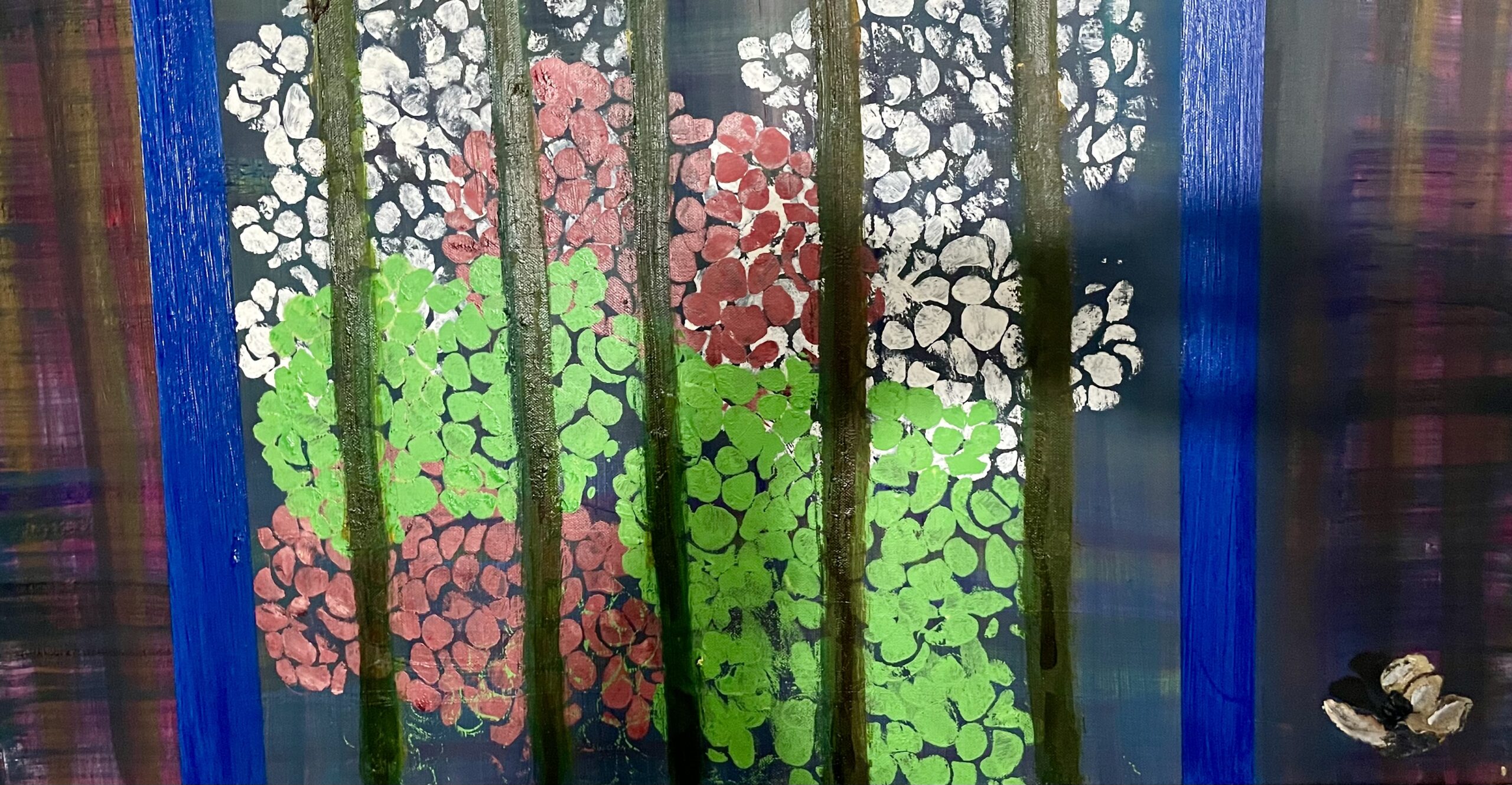
The painting I have uploaded is called Discarded Flower. You might want to use it for reflection, for Visio Divina, during Lent. Visio Divina is divine or holy looking. It recognises that all God’s creation engages and encounters us and mysteriously speaks to us of God, via the work of the Holy Spirit. It is about gazing, not glancing, about paying close attention, and not assuming immediately that you understand what you see. If we are open to the Spirit, we may be gifted with glimpses of God in all that is. But we can also learn to see as God sees, as we share in God’s life and practice this kind of looking.
Not everyone finds art work easy, so don’t worry if this does nothing for you. But, if you would care to, I would invite you to gaze at Discarded Flower. Pay close attention, and don’t jump to conclusions. What do you see, colours and forms? Does it resonate with anything for you? Are there words of Scripture which might reinforce what it seems to say, or contradict it? Does it remind you of anything else? A poem? An incident? What attracts you to it or repels you from it? Might God be drawing you to some insight, some grace through the painting? It may help some people to ask God how it might relate to you or to your or another’s life / the life of the world?
As a painting it participates – at least I believe it does- in God’s creative nature. Remember that St Dionysius said the question God will ask us at the judgement is, “Have you enjoyed my creation?” Talk with God about it. Through it, is God calling you to be or say or do something? It may lead you into prayer, praise or intercession, or, as you gaze you may be drawn into the deep silence where we know God is present. As St Teresa of Avila said, sit and just allow God to love you.
Words for Lent
As we begin the first full week of Lent, I would like to share with you some words from my friend the Revd Dr Inderjit Bhogal, who is a retired Methodist Minister and the founder of the City of Sanctuary movement. https://cityofsanctuary.org
Inderjit writes:
‘Blessings for Lent to you and all who are special to you. Lent is an annual reminder to us all to consume less. But also to remember that the real fast is to work for justice (Isaiah 58:6-7). It is not about going without food yourself. It is more about ensuring no one goes without food. It is about so living that all have enough, that there is enough for all, enough for each.’
A collect for Lent
God of tenderness and compassion,
you desire the fast that gives bread to the hungry
and lets the oppressed go free.
Forgive our complacency,
renew our vision and courage,
that we may share in your work for justice,
and embody your steadfast love.
In Jesus’ name, Amen. (Helen Stanton)


